Published
Short answer: A pickleball court is 6.10 metres wide and 13.41 metres long (20 by 44 feet), the same for singles and doubles. The non-volley zone, or kitchen, runs 2.13 metres (7 feet) back from the net on each side. The net is 91.4 cm high at the sidelines and 86.4 cm in the middle, and USA Pickleball's minimum total playing surface, court plus run-off, is 9.14 by 18.29 metres (30 by 60 feet).
Every measurement
| Measurement | Metric | Imperial |
|---|---|---|
| Court width | 6.10 m | 20 ft |
| Court length | 13.41 m | 44 ft |
| Each half, net to baseline | 6.71 m | 22 ft |
| Non-volley zone (kitchen) depth | 2.13 m | 7 ft |
| Service court depth (kitchen line to baseline) | 4.57 m | 15 ft |
| Service court width (each) | 3.05 m | 10 ft |
| Net height at the sidelines | 91.4 cm | 36 in |
| Net height in the middle | 86.4 cm | 34 in |
| Line width | 5 cm | 2 in |
| Diagonal, corner to corner | 14.73 m | 48 ft 4 in |
The court is measured to the outside edges of the lines, and the same court is used for singles and doubles. Pickleball Australia's rules page gives the same figures in metres for Australian courts.
How the court is laid out
- –Baselines run across each end, and sidelines down each side.
- –The net splits the court into two halves of 6.71 metres each.
- –The non-volley zone, or kitchen, is the 2.13 metre strip on each side of the net. Its lines are part of the zone.
- –The centre line runs from the kitchen line to the baseline on each side, making a left and a right service court.
Lines are in. A ball that lands on a line counts as landing in the area that line bounds, with one exception: a serve that lands on the kitchen line is short, and a fault. How to play pickleball explains the serve and the kitchen rules.
How much space you need around it
Players need room to run behind the baseline and wide of the sidelines. USA Pickleball sets out these playing surfaces, court plus run-off:
| Playing surface | Metric | Imperial | Space beyond each sideline / baseline |
|---|---|---|---|
| Minimum | 9.14 × 18.29 m | 30 × 60 ft | 1.52 m / 2.44 m |
| Recommended for new courts and tournaments | 10.36 × 19.51 m | 34 × 64 ft | 2.13 m / 3.05 m |
| Stadium courts | 15.24 × 24.38 m | 50 × 80 ft | 4.57 m / 5.49 m |
The run-off figures are the difference between the playing surface and the 6.10 by 13.41 metre court, split evenly on each side. If you're building a court, talk to your council and your state association first. Pickleball Australia shares Pickleball Australia's facility development guidelines with clubs and councils on request.
Compared with badminton and tennis courts
| Court | Size | Net height in the middle |
|---|---|---|
| Pickleball | 13.41 × 6.10 m | 86.4 cm |
| Badminton (doubles) | 13.40 × 6.10 m | 152.4 cm |
| Tennis (doubles) | 23.77 × 10.97 m | 91.4 cm |
- –Badminton. A badminton doubles court is 13.40 by 6.10 metres (BWF Laws of Badminton), so its outer lines are, for practical purposes, a pickleball court. That's handy in a school or community hall. The badminton net is far too high, though, and the kitchen lines aren't there, so you'll need a pickleball net and some tape.
- –Tennis. A tennis doubles court is 23.77 by 10.97 metres, and its net is 91.4 cm in the middle and 1.07 m at the posts (the Rules of Tennis (Tennis Canada's 2026 edition of the ITF rules)). A pickleball court fits inside one with room to spare, but a tennis net is 5 cm too high in the middle and more at the sides. How many pickleball courts you can line on a tennis court depends on the fenced area around it, so ask the club or council before you get the tape out.
Marking out a court at home
You don't need a permanent court to play. Chalk, masking tape or throw-down lines on a flat driveway, carpark or school court will do.
- Find a flat space. For a full court with room to move, you want about 9.14 by 18.29 metres (30 by 60 feet), USA Pickleball's minimum playing surface. A driveway hit can make do with less.
- Mark the outside rectangle. Mark a rectangle 6.10 metres wide and 13.41 metres long. Measure to the outside edges of the lines: the lines are part of the court.
- Check it's square. Measure both diagonals, corner to corner. On a true court each is about 14.73 metres (48 feet 4 inches). If they differ, adjust until they match.
- Mark where the net goes. The net line runs across the middle, 6.71 metres (22 feet) from each baseline.
- Mark the kitchen lines. Mark a line 2.13 metres (7 feet) from the net on each side, parallel to it. The strip between this line and the net is the non-volley zone, or kitchen.
- Mark the centre lines. On each side, run a centre line from the kitchen line to the baseline, splitting that half into two service courts 3.05 metres wide.
- Set the net height. Set the net at 91.4 cm (36 inches) at the sidelines and 86.4 cm (34 inches) in the middle.
Lines are 5 cm (2 inches) wide on a proper court, which is wider than most tape, so lay two strips side by side if you want it exact.
Kit for a home court
- –A net. Portable pickleball nets are sold in sets with legs and a frame. Check it sets to the heights above.
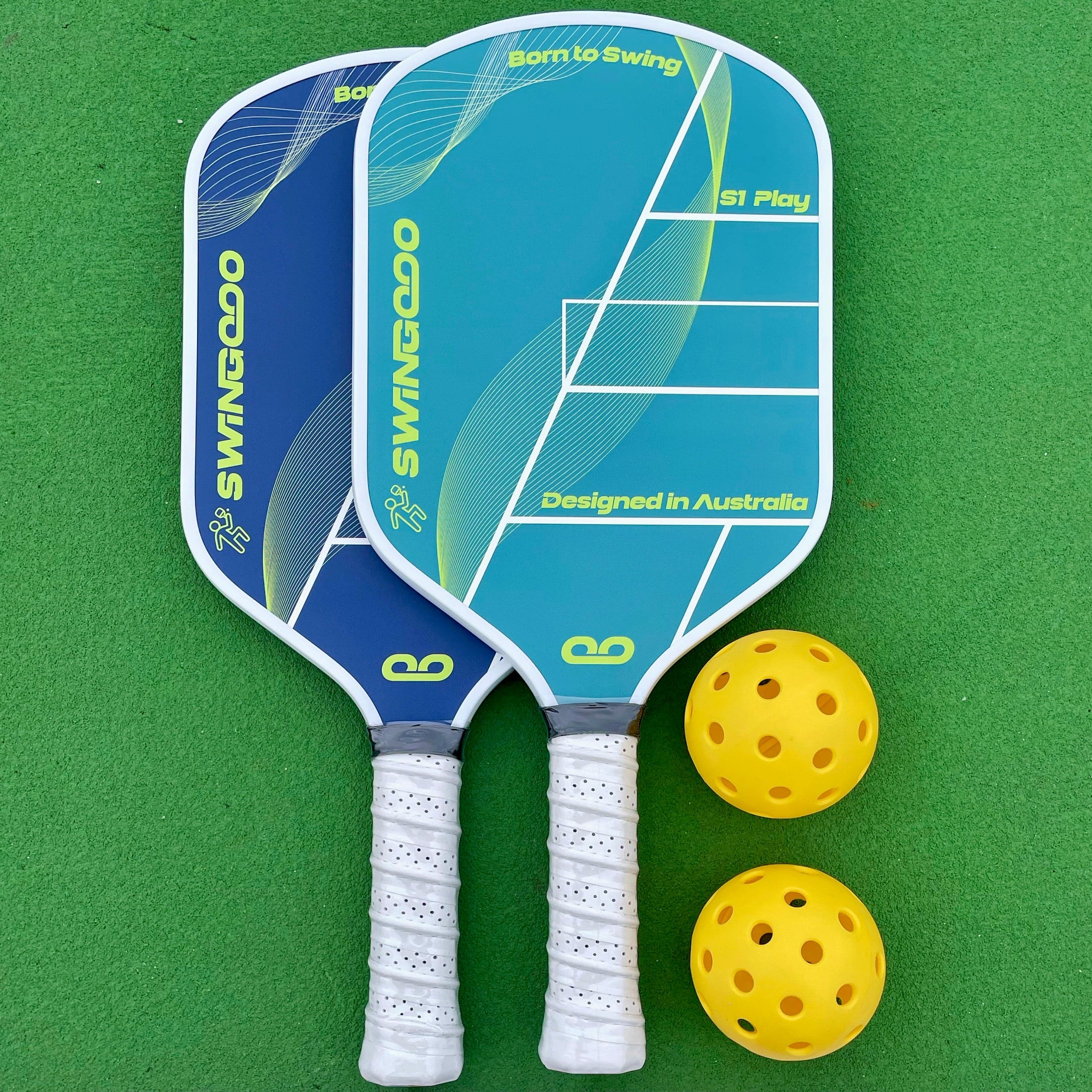
- –A paddle each. The S1 Play Set ($169.99) has two paddles and two outdoor balls; a family doubles game needs four paddles.
- –Outdoor balls. For a driveway or any outdoor court, use outdoor balls: they're harder and fly straighter in the wind. Indoor vs outdoor balls has the detail.
Not sure which paddle suits you? Our paddle matcher asks four questions.
Sources
- –2026 USA Pickleball Official Rulebook: rule 3.A (court, lines and playing surface) and 3.B (net).
- –Pickleball Australia rules and scoring: Australian court measurements in metres.
- –BWF Laws of Badminton, law 1 and diagram A.
- –the Rules of Tennis (Tennis Canada's 2026 edition of the ITF rules), rule 1.