Published
Short answer: Match the paddle to how you play now, not how you hope to play. New and social players do best with a forgiving fibreglass or blended face, a standard shape, a midweight build and a grip that fits. Improving players can add carbon for a crisper feel; advanced players often want a stiff carbon face and a thermoformed build. You only need a paddle from an approved list if you'll play sanctioned tournaments.
The quick version
| New or social | Improving | Advanced | |
|---|---|---|---|
| Face | Fibreglass or a blend | A blend or carbon | Carbon, often raw carbon |
| Core | 12 to 16mm | 14 or 16mm, by style | 14 or 16mm, by style |
| Shape | Standard | Standard or hybrid | Any; elongated for reach |
| Weight | Midweight | Midweight | To taste: heavier for drive, lighter for hands |
| Build | Standard | Standard | Thermoformed is worth a look |
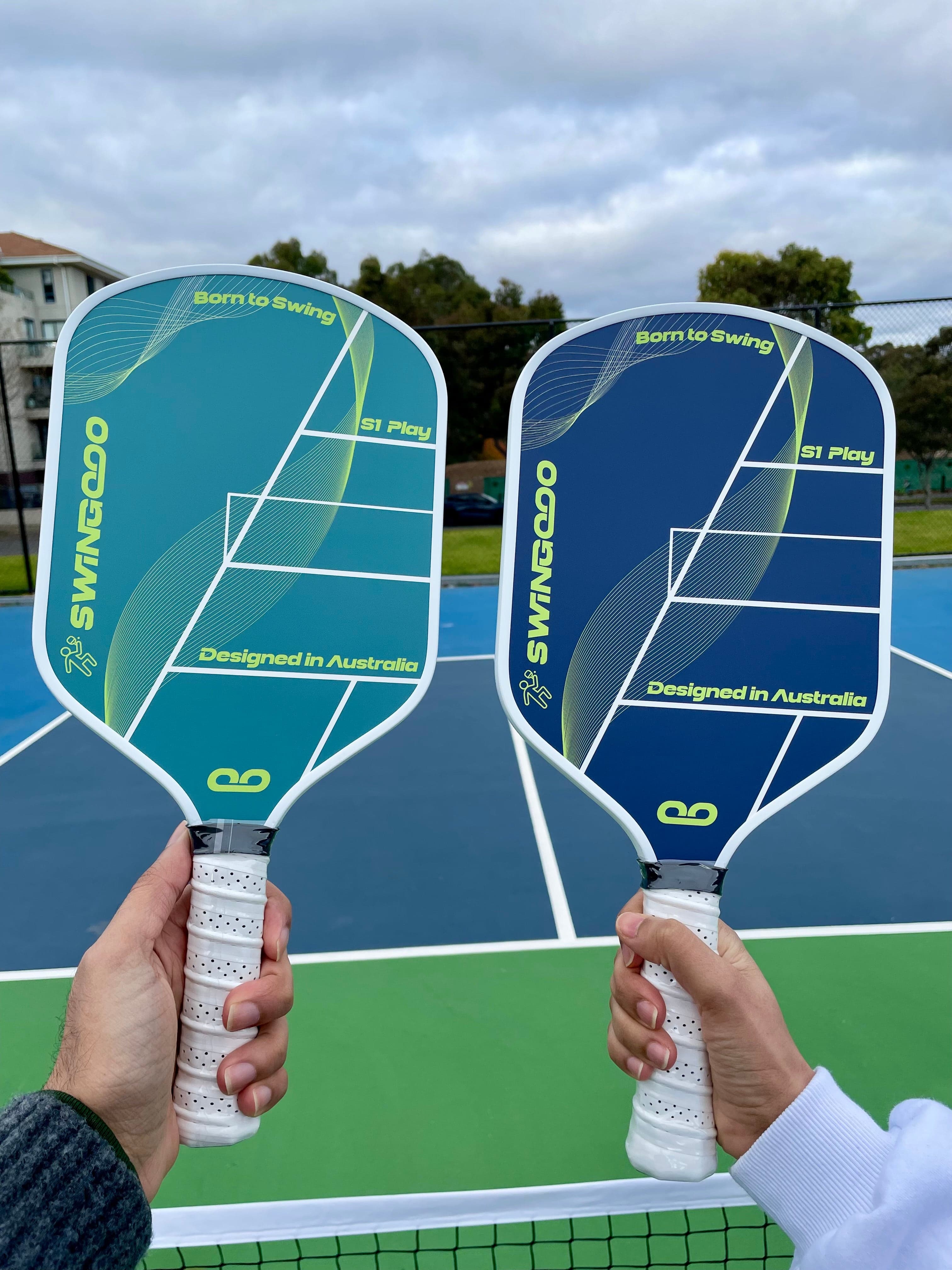
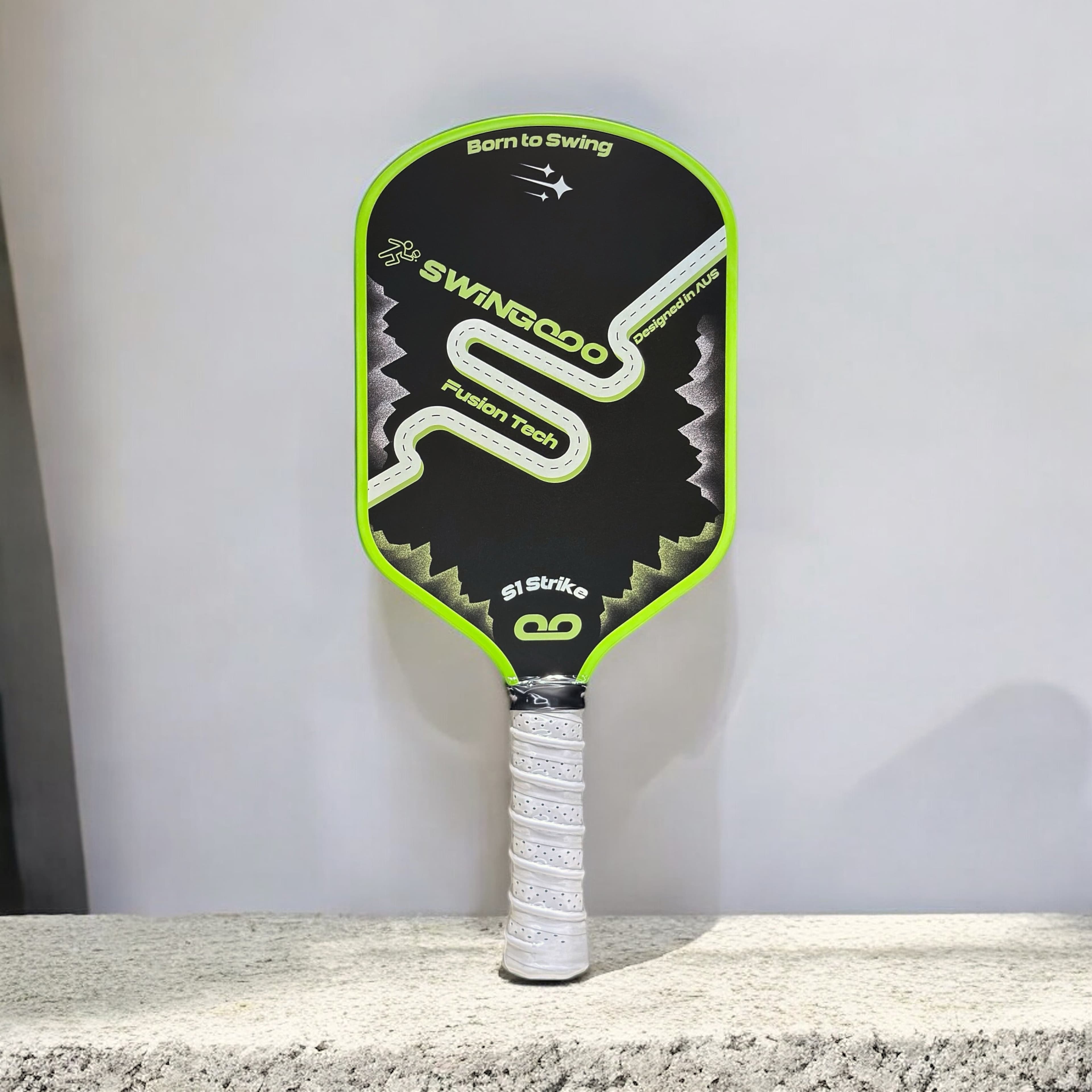
| Our paddle | S1 Play | S1 Strike | S1 Pro Carbon |
That table covers most people. The rest of this guide explains each line, so you can make the call for your own game.
1. The face: fibreglass, carbon or both
The face is the part that meets the ball, and its material sets the feel.
- –Fibreglass flexes a little on contact. It's forgiving and lively, which suits new players.
- –Carbon fibre is stiffer for its weight. It feels crisper and more predictable and rewards clean contact.
- –A blend of the two aims for touch from the fibreglass and drive from the carbon.
Surface texture matters too, and it's regulated: USA Pickleball's rules ban rough texturing and paints or materials that add spin, and approved paddles are tested for roughness and spin (2026 USA Pickleball Official Rulebook, rule 3.D.5). The full comparison of face materials is in fibreglass vs carbon.
2. The core: how thick
Under the face is a honeycomb core, usually polypropylene, anywhere from about 10 to 20mm thick (Pickleball Warehouse). Thicker cores tend to feel softer and more controlled; thinner cores tend to be livelier, with more pop. Neither is wrong for a beginner. 14mm vs 16mm explains the trade-off.
3. The shape
USA Pickleball's rules cap a paddle at 17 inches long, with length and width together no more than 24 inches, and set no limit on thickness or weight (USA Pickleball rulebook, rules 3.D.2 and 3.D.3). Within that box, makers trade face width for reach:
- –Standard paddles are roughly 16 inches long by 8 inches wide (41 by 20 cm), with the biggest, most central sweet spot. Start here.
- –Hybrid shapes, roughly 16.25 by 7.75 inches, sit between the two.
- –Elongated paddles run to roughly 16.5 by 7.5 inches (42 by 19 cm). More reach and more power for the same swing, but less forgiving side to side and a little slower in quick exchanges at the net.
Those sizes are from Paddletek's shape guide; every maker's are a little different.
The S1 Play is a standard shape, which is what we'd give anyone in their first year.
4. The weight
Most listings give paddle weight in ounces. There's no official standard for the bands, and retailers draw the lines slightly differently, but Pickleball Warehouse's guide is typical:
| Band | Weight | What it does |
|---|---|---|
| Light | 7.4 oz (210 g) or less | Quick hands at the net, easy on the arm, less power and stability |
| Midweight | 7.5 to 8.2 oz (213 to 232 g) | The middle ground, and a sensible start |
| Heavy | 8.3 oz (235 g) and over | More drive and stability, more work for your wrist and elbow |
A heavier paddle carries more momentum into the ball, so it drives harder and is steadier when a hard hit arrives off-centre. A lighter one is quicker in fast exchanges at the net and kinder over a long session. If you're new, or your wrist or elbow complains, stay midweight or lighter.
If a listing doesn't give a weight (ours don't yet), ask the seller before you buy.
5. The grip
Grip size is the distance around the handle, and most run from 4 to 4.5 inches (102 to 114 mm). A grip that's too thick tires your forearm; too thin and the paddle twists in your hand on off-centre hits.
To check your size, Pickleball Central's guide says to measure from the middle crease of your palm to the tip of your ring finger. If you're between sizes, go smaller: a typical overgrip adds about 1/16 inch, but nothing takes thickness away.
Handle length matters too. A longer handle leaves room for a two-handed backhand; a shorter one leaves more of the paddle for the face.
6. The build: standard or thermoformed
Most paddles are cold-pressed: the faces are glued to the core and an edge guard goes on afterwards. Thermoformed paddles are moulded with heat and pressure so the faces, core and edge become one sealed unit. They usually cost more and play a little livelier. Thermoformed vs standard paddles covers the trade-offs, including the problems early thermoformed paddles had.
7. Approved lists and tournaments
USA Pickleball's rules set the limits every paddle is measured against: size, surface, and since October 2026 a spin test for paddles submitted for approval (USA Pickleball on the spin rate test). Being on an approved list means the maker submitted the paddle, an independent lab tested it, and it was listed.
- –For social play, club nights and learning, you don't need an approved paddle.
- –For Pickleball Australia sanctioned tournaments, you need a paddle that has passed testing by USA Pickleball or UPA-A, as shown on either approved list (Pickleball Australia player FAQ). Pickleball Australia also tests paddles on site (Pickleball Australia paddle testing).
- –Check the list itself, not the sticker. Pickleball Australia warns that some knock-off paddles carry a printed approval stamp.
None of our paddles are on either approved list, so they're for social, club and practice play, not sanctioned tournaments.
8. The budget
Spend on fit, not stickers. A first paddle should have a textured face, a decent core and a grip that fits; it doesn't need to be the stiffest carbon on the shelf. Once you're playing every week and know how you like to hit, it's worth paying for the feel you want.
Our range is a ladder, one paddle for each stage:
| Paddle | Face | Core | Built for | Everyday price |
|---|---|---|---|---|
| S1 Play | Grit-coated fibreglass | 12mm polymer honeycomb | New players | $99.99 |
| S1 Strike | Fusion Tech (fibreglass + carbon fibre) | 14mm or 16mm, polypropylene honeycomb | Improving players | $159.99 |
| S1 Pro Carbon | Raw 3K carbon fibre | 14mm | Intermediate to advanced | $189.99 |
Not sure where you sit? Our paddle matcher asks four questions and suggests one, or compare all three side by side.
9. Try before you buy
- –Borrow. Many clubs keep loan paddles for come-and-try sessions. Our where to play guide lists the association and clubs in every state and territory.
- –Swap with a friend for a few games. Ten minutes with someone else's paddle tells you more than any spec sheet.
- –Buy somewhere with returns. Ours can come back unused, in the original packaging, within 30 days.
Mistakes we see most
- –Buying the stiffest carbon first. It makes the soft game harder while you're learning.
- –Buying for power claims. Your swing makes the pace and the spin. The paddle helps at the margins.
- –A grip that's too thick. You can build a thin handle up; you can't shave a thick one down.
- –Thinking approved means better made. It means submitted, tested and listed. It's a tournament question, not a quality grade.
Sources
- –2026 USA Pickleball Official Rulebook, section 3 (court and equipment).
- –USA Pickleball Equipment Standards Manual: how paddles and balls are tested.
- –Pickleball Australia player FAQ: which paddles PA sanctioned tournaments accept.
- –Pickleball Warehouse paddle guide: core thickness and weight bands.
- –Pickleball Central paddle guide: measuring grip size.
- –Paddletek on paddle shapes.