Published
Short answer: Most paddle jargon describes one of three things: what the face is made of (fibreglass, carbon fibre, raw carbon, 3K, T700), how the paddle is built (cold-pressed, thermoformed, unibody, edge guard) and how it feels (pop, dwell time, sweet spot, swingweight, twistweight). One common mix-up: 3K and 12K describe how the carbon is woven, while T700 names the carbon fibre itself.
Face materials
The face is the part that meets the ball. These are the words you'll see for what it's made of.
Fibreglass. Glass fibre set in resin. It flexes more than carbon fibre on contact, so a fibreglass face feels forgiving and lively, which is why many starter paddles use it.
Carbon fibre. Carbon filaments set in resin. Stiffer than fibreglass for its weight, so a carbon face flexes less and feels crisper and more predictable, and rewards clean contact.
Hybrid or blended face. A face that combines fibreglass and carbon fibre, aiming for some give from the glass and some stiffness from the carbon.
Raw carbon. A marketing term, not a specification: a carbon face with no painted or printed coating over it, so the textured carbon surface meets the ball directly.
3K, 12K. How many thousand carbon filaments are bundled into each tow, the strand that's woven into the cloth: 3K is 3,000 filaments and 12K is 12,000. It describes the weave, not the quality.
T700. A carbon fibre grade made by Toray, which calls it a standard modulus fibre. Toray's datasheet for T700S gives a tensile strength of 4,900 MPa and a modulus of 230 GPa. It names the fibre, not the weave: Toray sells T700 in 6K, 12K and 24K tows.
Unidirectional (UD) carbon. Carbon sheet with every tow laid parallel instead of woven. It's very stiff along the fibres, so makers stack layers at different angles.
Peel ply. A release fabric laid on the face during moulding and peeled off afterwards. It leaves its texture pressed into the resin, so the face has grip without anything added on top.
Textured face. Any face finish that helps it grip the ball, from a peel ply texture to raw carbon. USA Pickleball's rules limit how rough a face can be, and approved paddles are tested for roughness and spin.
Core and construction
Under the face is the core, and how the layers are joined is the build.
Honeycomb core. The layer between the two faces, made of hexagonal cells. Polypropylene honeycomb is the most common core material.
Core thickness. How thick the core is, typically about 10 to 20mm. Thicker cores tend to feel softer and more controlled; thinner cores tend to feel livelier, with more pop.
Cold-pressed. The standard build: the faces are glued to the core with epoxy and pressed, and an edge guard is fitted afterwards.
Thermoformed. Moulded with heat and pressure so the faces, core and edge fuse into one sealed unit, usually with the face sheets folded over the edge.
Unibody. Another name for a thermoformed, single-piece paddle. You'll also see uni-frame and single-piece.
Foam-filled edge. Foam set around the edge of the honeycomb core in many thermoformed paddles, often sold as foam-injected. Teardowns by Pickleball Science found it doesn't add structural rigidity to the edge.
Edge guard. A plastic or rubber strip around the rim that protects the edge from scrapes and court hits.
Edgeless. A paddle with no separate edge guard: the edge is moulded as part of the paddle. It needs more care against court scrapes.
Delamination. The face separating from the core. Pickleball Science traced 2023 cases in thermoformed paddles to crushed cores, which also made the paddles play hotter.
Shape, weight and feel
How a paddle swings and responds.
Standard shape. Roughly 16 inches long by 8 inches wide, with the largest and most central sweet spot. The forgiving choice for most players.
Hybrid shape. Roughly 16.25 by 7.75 inches: a little more reach than a standard paddle and a little less face width.
Elongated shape. Roughly 16.5 by 7.5 inches. More reach and more power for the same swing, but less forgiving side to side and a little slower at the net.
Sweet spot. The area of the face where contact feels solid and the ball comes off cleanly.
Pop. How quickly the ball comes off the face for a given swing. More pop means more pace with less effort.
Dwell time. The fraction of a second the ball stays on the face. Softer, thicker paddles feel like they hold the ball longer, which players link with control.
Swingweight. How much a paddle resists being swung, measured about an axis near the end of the handle. Higher swingweight means more power and a slower swing.
Twistweight. How much a paddle resists twisting around the handle when you hit off-centre. Higher twistweight means a more stable face on mishits.
Grip size. The distance around the handle, usually 4 to 4.5 inches. Measure from the middle crease of your palm to the tip of your ring finger.
Overgrip. A thin wrap over the handle for tack and sweat. A typical one adds about 1/16 inch to the grip size.
Rules, testing and balls
What the approval stamps and ball labels mean.
USA Pickleball approved. A paddle or ball the maker has submitted for testing by an independent lab and that USA Pickleball lists in its public database. Required at USA Pickleball sanctioned events.
UPA-A approved. The other approval list Pickleball Australia accepts: its sanctioned tournaments need a paddle that has passed testing by USA Pickleball or UPA-A.
Power test (PBCoR). USA Pickleball's test of how fast a ball rebounds off a paddle, which caps how powerful a paddle can be. The limit was tightened from 1 November 2025.
Spin test. From 1 October 2026, paddles submitted to USA Pickleball for approval must spin a test ball at no more than 2,100 rpm.
Indoor ball. A softer, lighter ball with about 26 larger holes, made for smooth hall floors.
Outdoor ball. A harder, heavier ball with about 40 smaller holes, so the wind moves it less. Hard outdoor balls are more likely to crack in the cold.
How our paddles use these terms
- –The S1 Play: grit-coated fibreglass face, 12mm polymer honeycomb core, standard shape.
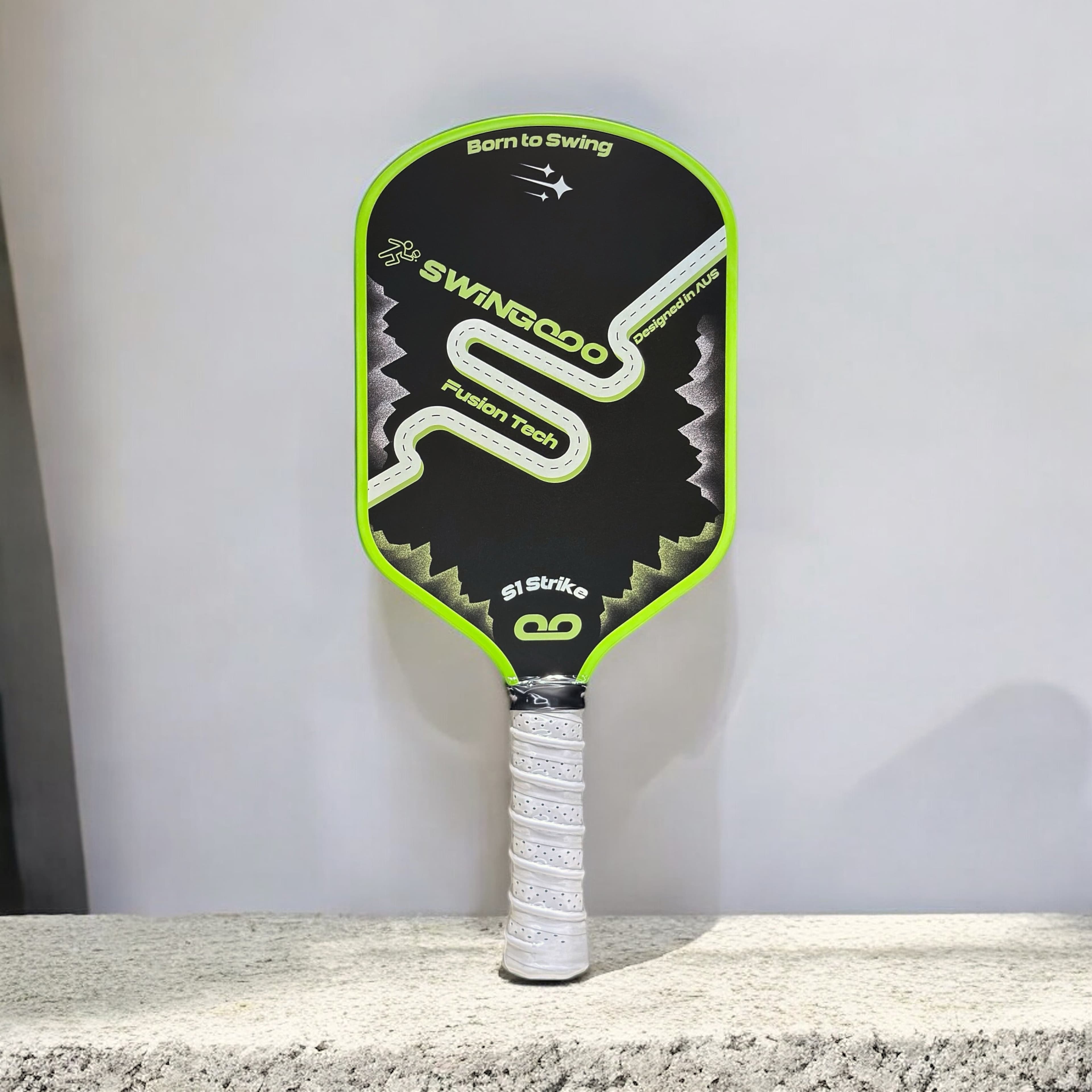
- –The S1 Strike: a hybrid face, Fusion Tech (fibreglass + carbon fibre), over a polypropylene honeycomb core in 14mm or 16mm.
- –The S1 Pro Carbon: raw 3k carbon fibre face, thermoformed unibody, 14mm core.
None of them are on an approved list. The guides go deeper on fibreglass vs carbon, 14mm vs 16mm and thermoformed vs standard, or compare the three paddles.
Sources
- –Carbon tows and weaves: Tennis Warehouse University on carbon layups and Pickleball Science on paddle materials, which also covers raw carbon and peel ply.
- –T700: Toray's T700S datasheet.
- –Construction: Pickleball Warehouse's paddle guide, Pickleball Science on edge construction and crushed cores.
- –Core thickness and grip size: Pickleball Warehouse and Pickleball Central.
- –Shapes: Paddletek's shape guide.
- –Swingweight and twistweight: Pickleball Warehouse and Pickleball Science.
- –Rules and testing: 2026 USA Pickleball Official Rulebook (rule 3.D), USA Pickleball Equipment Standards Manual, USA Pickleball on the spin rate test and Pickleball Australia player FAQ.
- –Balls: Pickleball Warehouse's ball guide.