Published
Short answer: A thermoformed paddle is moulded with heat and pressure so its faces, core and edge become one sealed piece. A standard, cold-pressed paddle is glued together in layers, with an edge guard added afterwards. Thermoformed paddles tend to play a little livelier, feel solid right to the edge and usually cost more. Early ones, around 2023, had well-documented problems with crushed cores and delamination, which is part of why paddles are now tested for power.
Two ways to build a paddle
Every paddle is a sandwich: two face sheets over a honeycomb core, with something finishing the edge. The difference is how the layers are joined.
- –Cold-pressed paddles are assembled with epoxy glue and pressed together, layer by layer, and the edge guard goes on separately (Pickleball Warehouse). It's the standard way to make a paddle, and most paddles are built like this.
- –Thermoformed paddles go into a heated mould under pressure, which fuses the face, core and edge into a single unit (pickleball.com). The face sheets are typically folded over the edge of the paddle (Pickleball Science). You'll also see this sold as unibody, uni-frame or single-piece construction.
Side by side
| Cold-pressed (standard) | Thermoformed | |
|---|---|---|
| How it's made | Faces glued to the core and pressed; edge guard added afterwards | Faces, core and edge moulded together with heat and pressure |
| Edge | A separate plastic or rubber edge guard | Sealed, often with a foam-filled edge wall |
| Feel | Familiar and consistent | A little livelier |
| Price | Usually lower | Usually higher |
| Known issues | Edge guards can work loose over time | Early models delaminated and got more powerful with use |
| Also called | Standard build | Unibody, uni-frame, single-piece |
The feel and price lines are how retailers describe the two builds: Pickleball Warehouse says thermoformed paddles play "a bit livelier", and pickleball.com notes they usually sit at a higher price. Paddles vary, so treat the table as a guide, not a rule.
What a foam-filled edge does (and doesn't)
Many thermoformed paddles have foam around the edge of the honeycomb core. You'll see it marketed as foam-injected. Pickleball Science, which cuts paddles open to see how they're made, found the foam is likely placed around the core before moulding, and that it does not add structural rigidity to the edge (its teardown). So buy a paddle for how it plays, not for an edge-foam claim.
The 2023 problem: delamination and "hot" paddles
When thermoformed paddles took off in 2023, some started to change as they were used.
- –Delamination. Pickleball Science's tests in May 2023 found delamination appeared to affect thermoformed paddles exclusively, and that the cracks reduced face stiffness, giving the paddle more pop (May 2023). By September 2023 it had traced the root cause to crushed cores (September 2023).
- –Paddles that got hotter. The Dink reported that some paddles got hotter and more powerful the more they were used (The Dink, August 2024).
The governing bodies responded with testing. USA Pickleball's equipment manual added a power test, limiting how fast the ball can come off the face, with the limit tightened from 1 November 2025 (USA Pickleball Equipment Standards Manual, section 2.E.6). From 1 October 2026, paddles submitted for approval must also pass a spin test (USA Pickleball on the spin rate test). Pickleball Australia tests paddles on site at events for deflection, surface roughness and structural integrity (Pickleball Australia paddle testing).
Makers have had three years to learn from it, but the lesson for buyers stands: a paddle that suddenly feels more powerful, sounds different or shows a soft spot on the face may be breaking down inside.
Who should buy thermoformed?
- –Advanced players with consistent contact who want a lively, solid feel across the whole face. That's who it's for.
- –Not beginners. A standard build is cheaper and does everything a new player needs. Spend the difference on balls and court time.
- –Tournament players: check the paddle is on a current approved list before an event. Approvals can be withdrawn, and Pickleball Australia sanctioned events need a paddle tested by USA Pickleball or UPA-A (Pickleball Australia player FAQ).
Where our paddles sit
| Paddle | Build | Face | Core | Everyday price |
|---|---|---|---|---|
| S1 Play | Edge guard | Grit-coated fibreglass | 12mm polymer honeycomb | $99.99 |
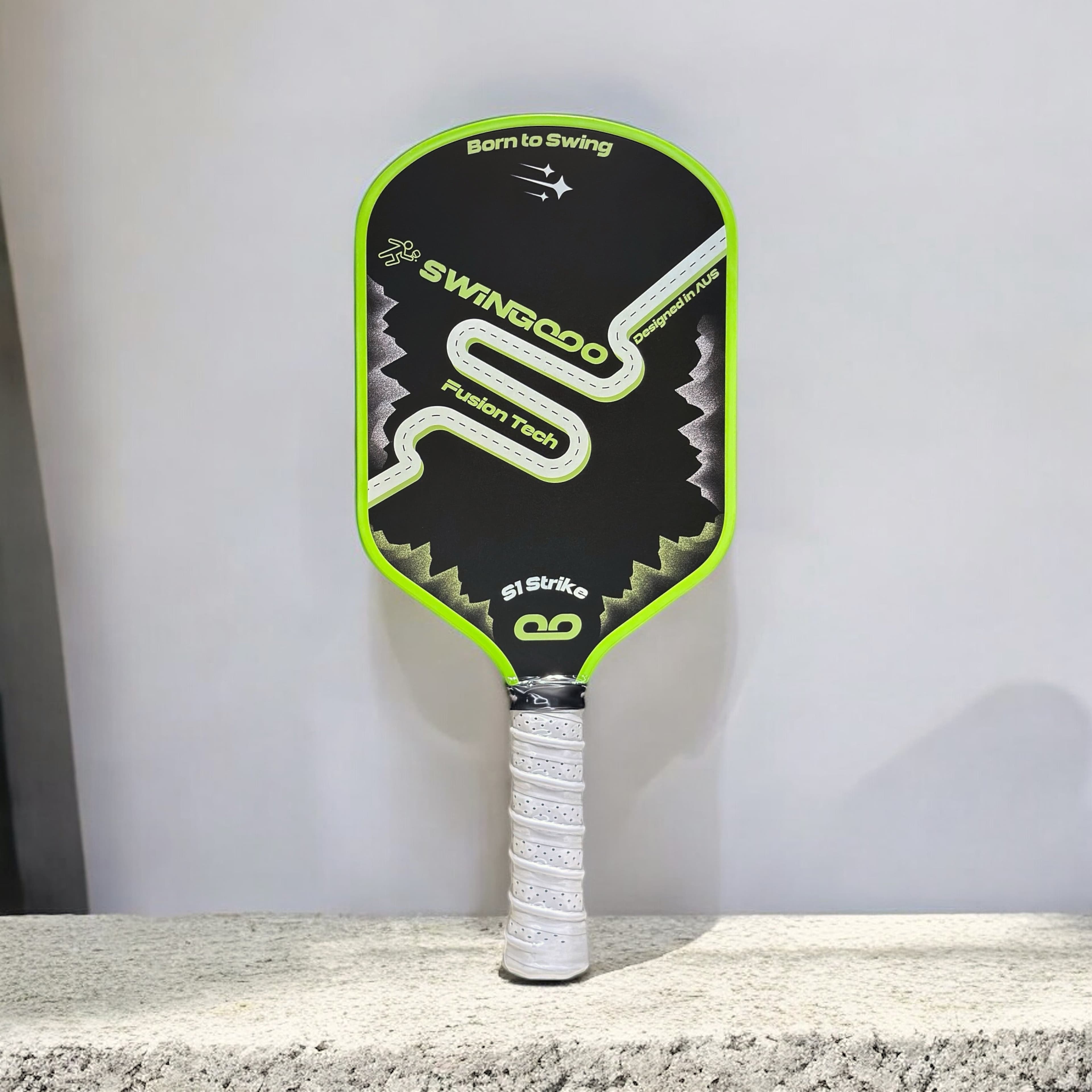
| S1 Strike | Edge guard | Fusion Tech (fibreglass + carbon fibre) | Polypropylene honeycomb | $159.99 |
| S1 Pro Carbon | Thermoformed unibody | Raw 3K carbon fibre | 14mm | $189.99 |
Only the S1 Pro Carbon is thermoformed. The S1 Play and S1 Strike are finished with an edge guard around the rim.
To be straight with you: none of our paddles are on an approved list, so the Pro hasn't been through USA Pickleball's power or spin tests. It's built for social, club and practice play. If any of our paddles develops a fault, such as a face separating, we'll repair, replace or refund it, and for a major failure you choose a refund or a replacement. Our returns page has the details.
Choosing between the three? Compare them side by side, or read fibreglass vs carbon and 14mm vs 16mm.
Sources
- –Pickleball Warehouse paddle guide: how cold-pressed and thermoformed paddles are made.
- –pickleball.com: what is a thermoformed paddle.
- –Pickleball Science: edge construction, delamination, May 2023, crushed cores, September 2023.
- –The Dink: USA Pickleball's new paddle testing standards.
- –USA Pickleball Equipment Standards Manual and USA Pickleball on the spin rate test.
- –Pickleball Australia paddle testing.